Assistive technology for writing & cognition
Keep writing in your own voice.
When the words get harder to reach — after a stroke, with memory changes, with ADHD or dyslexia, or simply with age — Assistive Writer helps you keep going. You bring the thoughts. It brings the speed, the typing, and the memory. You stay in charge of every word.
Built from your own words · guided by real people · you approve everything
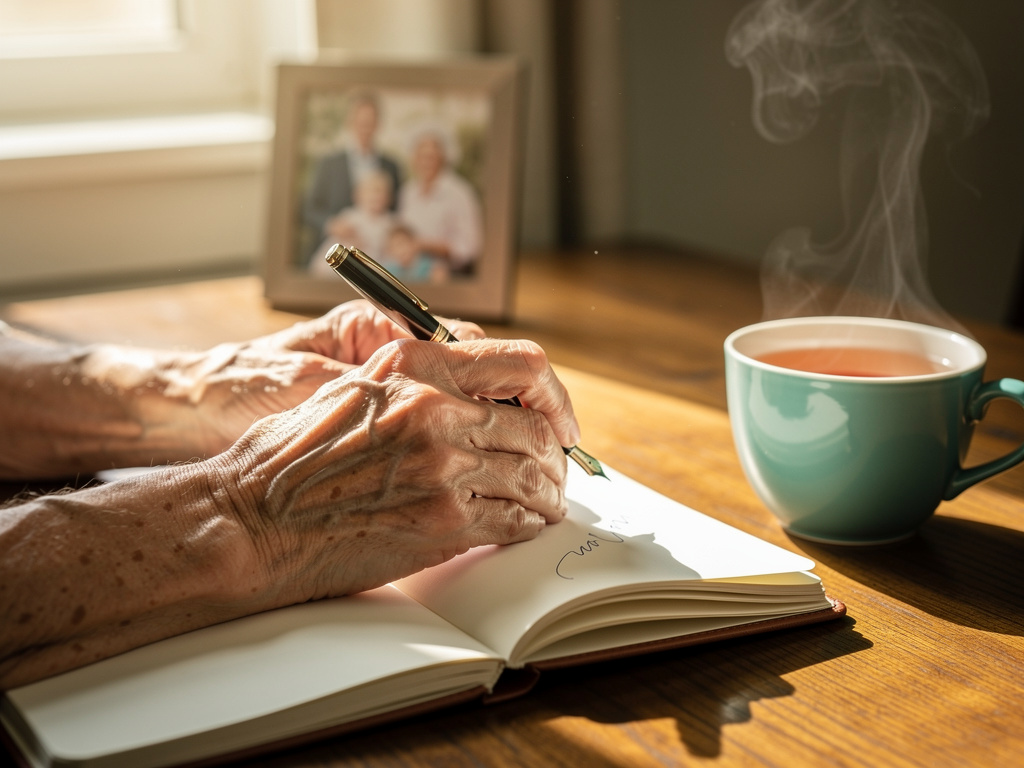
The thoughts are still there. We rebuild the bridge to the page.
Many people still have the stories, the knowledge, and the letters they mean to write — but the path from mind to page has become hard. A blank page asks for the very things that are difficult. Ordinary writing tools don’t help, and generic AI replaces your voice with its own.
Assistive Writer is different. It learns your voice from your writing, holds the details you’d otherwise have to remember, and lets you write by simply talking. It doesn’t do the thinking for you. It carries what you think the last, hardest mile — to real, finished writing that sounds like you.
How it works
Three simple steps. A specialist from our team can set all of this up with you.

Your voice becomes the style
We gather what you’ve already written — letters, emails, books, notes — so your writing partner learns how you write, not how a machine writes.

Add your memory aids
Photos, documents, names, dates, a life timeline — the details that jog memory and keep every page grounded in your real life.

Write by talking
Have a conversation. Take a walk and talk it through. Your partner handles the typing and remembers everything — and you approve what stays.
Who it’s for
If the ideas are intact but getting them out has become hard, this can help.
Memory changes & aging
Mild cognitive changes and early memory loss — keep the memoir, the family history, and the daily letters going.
Stroke & aphasia
Rebuild the bridge to language, using your own words as the scaffold, at your own pace.
Parkinson’s, ALS & MS
When the hand or the speed slows, the mind still leads. You direct; the tool types.
Brain injury recovery
A patient, steady partner that holds the thread so you don’t have to hold all of it at once.
ADHD & dyslexia
Capture the flood of ideas; let the tool handle spelling, order, and mechanics.
Writers racing the clock
A lifetime of knowledge and a partner that never tires — finish the work while the voice is yours.
A true partnership
You lead. It assists. Neither of you works alone.
You bring the vision, the taste, and the truth of your own life. Your writing partner brings speed and perfect recall. That division of labor is the whole idea — assistance, never replacement. Every sentence is yours to keep, change, or set aside.

What it looks like
You speak in pieces, the way anyone does. It gives you back finished writing — in your own voice. Here’s an illustration.
What you say
“Tell my granddaughter about… the summer we drove to the lake. The old green car. Her mother was small then. We sang the whole way. I want her to know it was happy.”
What appears — in your voice
Dear Ellie, I want to tell you about the summer we drove to the lake, back when your mother was still small. We had an old green car, and we sang the whole way there — every song we knew, and some we made up. I’ve been carrying that day with me for a long time, and I wanted you to have it too: it was happy, start to finish.
An illustration of how spoken fragments become finished writing. Not a real patient — every real page is built from the person’s own words, and they approve it.
You’re never doing this alone
We don’t replace the people who already care for someone — we equip them. The clinician, the therapist, the family member who knows the patient best stays in the lead. We bring the training and the technology behind them.
You know them best
The people closest stay in charge
You know this person better than anyone — their story, their abilities, their needs. You keep working with them, just as you always have. Nothing about that relationship changes.
We train you or your staff
We handle the technical part
We train you or your team on the tool, so you can guide them through the technical nuances — and you bring what you already understand about their abilities and the real disability in front of you.
It teaches as they go
The system reinforces the learning
As the patient learns to use it, the system reinforces that learning — gentler and more familiar with every session, so progress builds on itself.
📞 And help is always a phone call away. A real person — never a menu — whenever you or the patient get stuck.
Your voice stays
You build it in life. And when you’re gone, your family still has it.
Everything your partner knows is drawn from your own words, reviewed by people who care. So the writing can continue — a grandchild can still ask, the letters can still come, and your voice remains, in your own words. We hold this with the gravity it deserves.

Built on trust
Your words, your consent
It’s built from your own writing, with your permission — always.
Grounded, never invented
It writes from your real record and is reviewed by real people. It won’t make things up.
Assistive, not medical
A tool that helps you write. It is not a treatment and makes no medical claims.
Private & yours
Your writing and your memories belong to you and your family.
Ready to keep writing?
Tell us a little about yourself or your loved one, and a Writing Specialist will reach out — gently, with no pressure — to talk through whether this is a good fit.